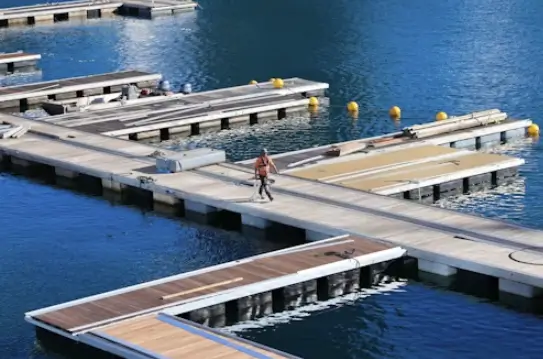
Engineering Floating Infrastructure for High-Tidal & Severe Weather Zones: Anchorage, Wave Attenuation, and Structural Resilience

Developing resilient marine infrastructure requires navigating complex environmental variables, particularly in regions prone to extreme weather. Coastal engineers must account for continuous kinetic forces exerted on structures by fluctuating water levels and turbulent wave action.
Traditional static infrastructure is increasingly proving inadequate when subjected to the compounding forces of modern climate-induced weather anomalies. To design structures that survive these conditions, engineers rely on precise coastal hydrodynamic modeling to predict the long-term structural fatigue on waterfront installations.
Hydrodynamic Stress Factors: Tidal Ranges, Wave Action, and Shear Loads
The destructive mechanisms acting upon marine structures are primarily driven by tidal amplitude, wind-wave periodicity, and persistent water current shear forces. High-tidal zones introduce severe vertical displacement, forcing infrastructure to constantly adjust to shifting hydrostatic baselines.
Traditional fixed piling docks face critical structural stress concentration during extreme wave action or macro-tidal events. Because these rigid structures cannot articulate with the water’s surface, the full kinetic energy of a wave is transferred directly into the foundational pilings.
Over time, this continuous bombardment causes micro-fracturing in concrete and lateral deflection in timber or steel pilings. When sheer loads exceed the foundational resistance, catastrophic structural failure becomes a mathematical certainty rather than a mere possibility.
Structural Dynamics of Modular HDPE Floating Systems
Flexural Elasticity and Energy Dissipation in High-Density Polyethylene
To mitigate the rapid energy transfer that destroys rigid structures, modern marine engineering heavily utilizes flexural absorption mechanisms. Unlike rigid concrete pontoons that violently reflect wave energy—often causing dangerous secondary turbulence—polymer-based floating systems yield to kinetic forces, effectively dissipating wave energy across a broader surface area.
To withstand dynamic torsional stress induced by high-wave actions, modern modular floating platforms rely heavily on high-molecular-weight polyethylene resins engineered with UV stabilizers. Technical documentation and mechanical test protocols from specialized floating dock manufacturers, such as Hiseadock, demonstrate that individual interlocking pontoon units can absorb localized impact forces while sustaining critical performance metrics.
Key technical parameters for these high-density modular systems include:
- Static Compression Load Capacity: Exceeding 350 kg/m².
- Operating Temperature Range: Maintaining structural integrity from -30°C to 70°C.
- Material Composition: High-Molecular-Weight High-Density Polyethylene (HMWHDPE) with anti-oxidation additives.
- Kinetic Energy Dispersion: High flexural elasticity for superior wave attenuation compared to rigid concrete matrices.
Modular Interlocking Systems: Pin Shear Strength and Load Distribution
The structural survivability of a modular floating system relies entirely on the mechanical integrity of its connecting nodes. In a high-density polyethylene matrix, individual pontoon cubes are joined using specialized connecting pins and interlocking convex-concave nodes.
Under extreme lateral tension and compressive stress, these connecting pins act as the primary load distribution network. When a wave strikes the outer edge of the platform, the resulting shear force is not isolated to a single point of impact.
Instead, the interlocking geometry forces the kinetic energy to travel through the connection pins, dispersing the sheer stress evenly across hundreds of adjacent modules. This micro-articulation prevents localized node snapping and maintains the overall geometric stability of the marina layout.
See also: Accounting for Small Business Owners: Essential Financial Reports Lenders Review
Advanced Anchoring Protocols for Dynamic Waterfront Environments
Seafloor Piling vs. Elastic Cable/Chain Mooring Matrix
The efficacy of any floating infrastructure is fundamentally dictated by its anchoring protocol. Proper waterfront infrastructure planning requires engineers to select anchoring systems based on exact bathymetric data, benthic substrate composition, and localized tidal maximums.
Steel guide pilings are traditionally favored for their high lateral resistance, allowing floating platforms to slide vertically along the pile during tidal shifts. However, in extreme deep-water environments or high-tidal zones, elastic mooring cables (such as Seaflex) or heavy-duty anchor chain systems provide superior multidirectional yielding.
To ensure stability, engineers must calculate the buoyancy reserve against the maximum dynamic loads. The anchoring matrix must allow enough vertical travel to accommodate storm surges while retaining enough tension to prevent lateral drifting.
Anchoring System Decision Matrix:
| Anchoring Method | Tidal Range Tolerance | Wave Energy Resistance | Maintenance Cycle | Ideal Benthic Substrate |
| Elastic Mooring (Seaflex/Cables) | High (> 5 meters) | Moderate–High | 3–5 Years Inspection | Sand / Mud / Soft Substrate |
| Steel Guide Pilings | Moderate (< 4 meters) | Very High | 8–10 Years (Corrosion Proofing) | Bedrock / Heavy Clay |
| Anchor Chain & Block System | High (> 6 meters) | High | 2–3 Years (Chain Wear Check) | Mixed Gravel / Deepwater |
| Modular HDPE Self-Anchoring | Moderate–High | High Elastic Energy Absorption | Near-Zero Maintenance | Intertidal / Shallow Water |
Extreme Weather Resiliency and Lifecycle Environmental Impact
Extreme Storm Surge Response and Rapid Modular Disassembly
When Category 4 or 5 cyclonic events threaten coastal infrastructure, survival often depends on emergency adaptability rather than sheer rigid strength. One of the primary engineering advantages of modular HDPE systems is the capacity for rapid localized disassembly.
Facility managers can swiftly decouple specific sections of the marina, relocating vulnerable assets to protected inland waterways before a storm surge makes landfall. This operational flexibility drastically reduces total asset loss during catastrophic weather events.
Beyond physical resilience, modern infrastructure must adhere to stringent marine conservation mandates. High-grade HDPE resists chemical corrosion and prevents microplastic shedding, ensuring no toxic compounds leach into the surrounding water column.
As climate-induced weather extremes become more frequent along vulnerable coastal zones, marina infrastructure must align with national environmental and coastal hazard mitigation guidelines. Designing resilient waterfront installations requires strict adherence to recognized oceanographic safety frameworks, such as those detailed in the NOAA coastal hydrodynamic hazards and wave energy standards, ensuring that floating structures reduce wave energy reflection while protecting fragile benthic marine ecosystems. compliance with ISO and CE international marine environmental standards guarantees a sustainable lifecycle from deployment to eventual recycling.