The Green Shift: Sustainable Material Compatibility in Modern Packaging Machinery

Introduction: The Eco-Friendly Pressure on Modern Packaging
The Transition from Multi-Layer Plastics to Mono-Materials
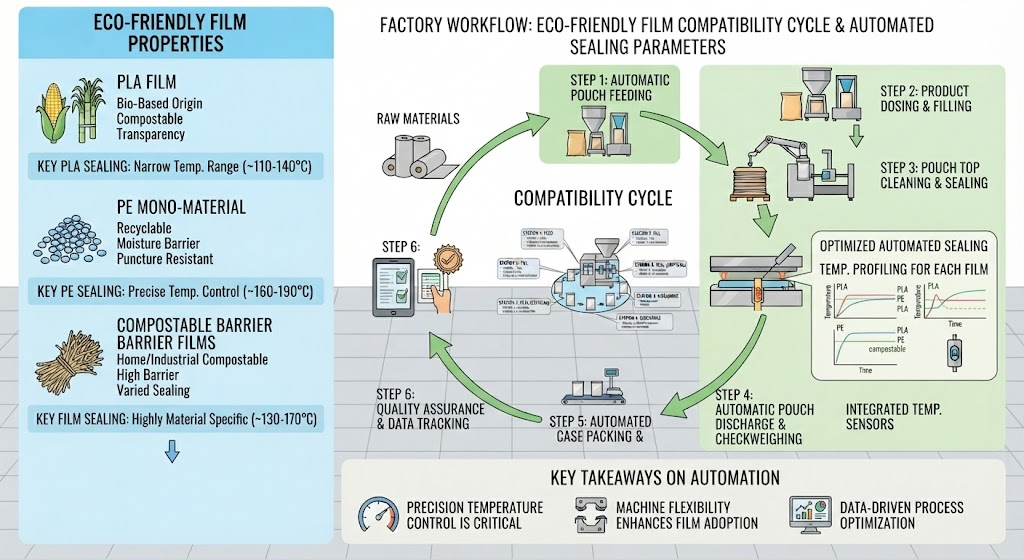
Driven by global sustainability regulations and evolving consumer awareness, manufacturers across sectors are abandoning traditional non-recyclable multi-layer plastics. Sustainable packaging strategies now center on mono-material structures—such as pure Polyethylene (PE) or Polypropylene (PP)—as well as plant-based Polylactic Acid (PLA) films. These materials facilitate closed-loop recycling and significantly lower cradle-to-grave carbon footprints.
Challenges in Sealing Biodegradable and Compostable Films
While eco-friendly films represent a massive leap forward for environmental stewardship, they present unique thermal and mechanical challenges on the factory floor:
- Narrow Thermal Windows: Eco-films melt easily or form weak seals if temperatures deviate slightly.
- Tension Sensitivity: Compostable materials exhibit different tensile strength under machine feeding.
- Material Friction: Recycled films often display inconsistent surface friction during bag opening.
How Modern Machinery Adapts to Sustainable Packaging Materials
Transitioning to eco-friendly pouches requires equipment that accommodates sensitive green materials without sacrificing sealing strength. Modern Levapack are engineered with adjustable thermal sealing profiles and delicate pouch-handling mechanisms to support recyclable mono-materials and compostable films seamlessly.
Precise Temperature Control and Sealing Pressure Adjustments
Next-generation machinery utilizes multi-zone digital PID temperature controllers coupled with pneumatic pressure adjustment. This ensures that delicate PLA films or recyclable mono-PE pouches receive exact heat exposure, forming air-tight seals without burning or blistering the outer packaging substrate.
Minimizing Film Scrap and Energy Consumption
Automated mechanical grippers reduce film strain during high-speed pouch transport. Coupled with low-power continuous heating elements and efficient servo drives, modern equipment cuts energy usage per unit packaged while virtually eliminating film scrap.
Case Study: Lowering Carbon Footprints on Production Lines
Energy Efficiency in Automated Rotary Stations
Modular rotary architecture minimizes mechanical motion overhead, reducing total line energy draw compared to legacy inline machinery. Facilities running recyclable mono-material films through optimized packaging lines achieve lower kilowatt-hour consumption per thousand packages produced, directly supporting scope 1 and scope 2 emissions reduction goals.
Key Takeaways
| Area | Key Takeaway | Impact/Data |
| Material | Switch to mono-PE/PP | Achieve zero-landfill goals |
| Quality | Adopt PID thermal control | Prevent film burn & leaks |
| Carbon | Deploy rotary packaging | Lower kWh per 1k units |
Final Thoughts on Circular Economy in Manufacturing
To ensure true environmental accountability, brand manufacturers frequently benchmark their packaging lifecycles against frameworks outlined by the Ellen MacArthur Foundation Circular Economy Guidelines, ensuring minimal waste generation across the entire production chain. Investing in sustainable-ready packaging machinery bridges the gap between environmental responsibility and industrial performance.