A Tuttle Roofer’s Field Notes On When An Old Roof Can Wait

The gutters on a 1990s ranch at the red-dirt edge of Tuttle fill with what looks like coarse black sand after every hard spring blow. The owner, six months into a first house, finds it while clearing the downspout and assumes the worst. Here is the short version, and it is what a roofer Tuttle OK homeowners trust will say in the driveway: granule in the gutter and a few curled tabs usually mean a roof that is aging, not one that is failing. Those are two different problems carrying two very different price tags. An honest inspection separates them. Replace too early and you spend thousands you did not have to spend, and wait too long on a roof that is genuinely finished and you pay for decking and drywall too.
Granule Loss Signals Wear Not Always Failure
Asphalt shingles shed. That is the design, not the defect. The mineral granules on the surface absorb ultraviolet punishment so the asphalt beneath them does not dry out and go brittle, and a roof that has stood through twenty-five Oklahoma summers will have thinned wherever the afternoon sun hits hardest. What we find most often on these older Tuttle roofs is lopsided wear, with the south and west slopes gone chalky while the north slope still photographs like new.
Hail changes the arithmetic. A 2025 study in Frontiers in Materials by Meisenzahl, Giammanco and Hedayati found that naturally weathered shingles struck by a high concentration of sub-severe hail lost roughly 30% more granules than non-weathered control shingles. An old roof and a new roof can take the same storm and come out in very different condition. Age is not simply age. It multiplies whatever the weather does next.
Curling tells a different story. Tabs lifting at the corners mean the mat underneath is drying out and losing its grip on the deck.
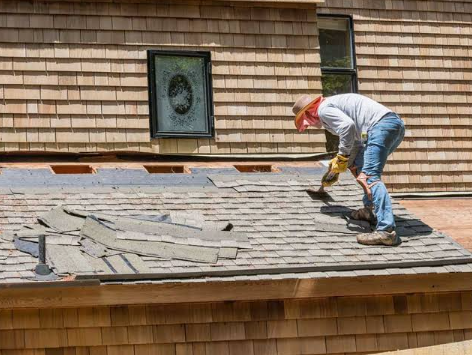
Read all of this from the ground. Binoculars from the driveway will show you curled tabs, missing shingles, and a sagging ridge line better than a wobbly ladder ever will. If a storm has just come through, look for downed wires before anything else. A fallen power line can energize the ground up to 35 feet away, and the Electrical Safety Foundation International says to stay back and call 911 rather than walk the yard. Roof access belongs to people who do it for a living, in a harness, wearing boots that feel where the decking has gone soft. (I have carried enough homeowners’ ladders back to the garage to feel strongly about that one.)
See also: The Real Math Behind a Stalled Back Injury Check on the Charleston Docks
A Targeted Repair Often Outlasts A Panic Replacement
The cost of getting this call wrong has climbed. Roofing Contractor reported in June 2026, citing Verisk data, that the average U.S. residential roof replacement reached $17,631 in 2025, a 33% jump over the 2021 through 2024 average. A repair that buys four more years is no delay tactic at those numbers. It is real money that stays in your account.
A landlord with a small rental west of town called last spring, certain she needed a full tear-off because a neighbor had just replaced one. Two slopes were fine. The damage sat on maybe eighteen square feet of west-facing plane above a valley, and that is exactly where the work went.
Run the numbers on that ranch. Say a targeted repair means 40 replaced shingles at $8 each, four hours of labor at $95 an hour, and a $150 trip and disposal charge, which comes to roughly $850 all in. Set that against a full replacement near $14,000 for the same house and the repair buys time at about 6% of the cost. Hold that repair five years and one enormous decision spreads across five ordinary budget years.
There is a limit to waiting, and the insurance industry has measured it. Verisk roof condition data, reported by Roofing Contractor, puts loss costs about 60% higher on homes whose roofs rate moderate or poor against those rated good or excellent. Push a worn roof past its useful life and the leak is only half your exposure, because underwriters price that condition band as well. An inspection exists to find the year you stop repairing, before the weather finds it for you.
Let A Local Roofer Make The Final Call
Wear versus failure is not a judgment you can make from a phone photo, and it is not one a door-knocking storm crew has much reason to make honestly. Ask whoever goes up there to show you what they saw: the slopes, the chimney flashing, the valleys, the pipe boots. On most jobs the boots and the flashing give out years ahead of the field shingles, and both are inexpensive to fix. A written inspection with photographs costs nothing at most local shops. It turns a guess into a decision.
So keep the granules in proportion. Clear the gutters, look the roof over from the ground twice a year and after any hailstorm, and get that written inspection before you sign anything. A roofer Tuttle OK owners have worked with before will tell you plainly when an $850 repair is the right answer and when the shingles are on borrowed time. On a 1990s ranch carrying decades of red-dirt wind, that distinction is worth more than any estimate.